


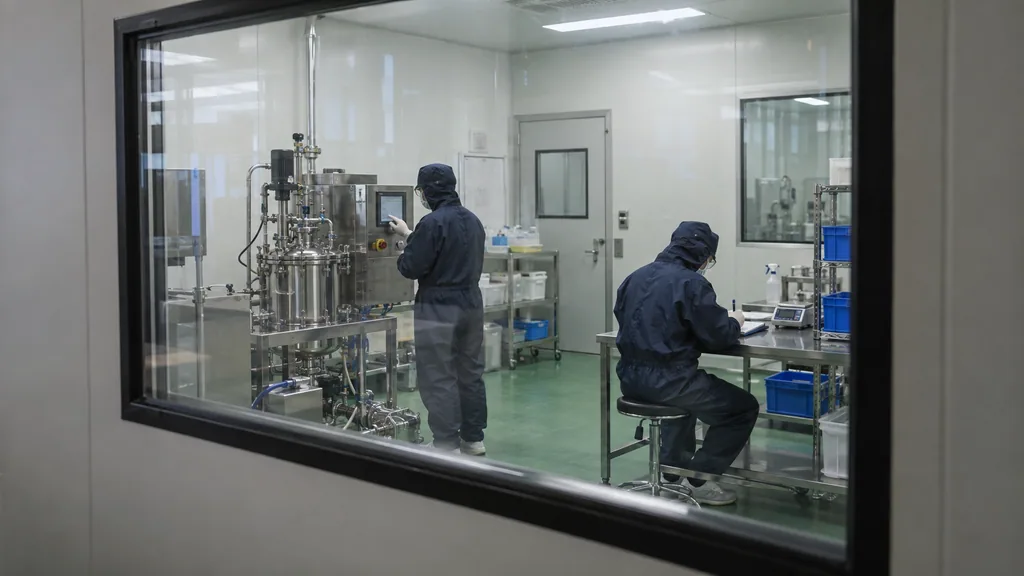
The most expensive machine in a peptide plant can still sit waiting for a purification slot. That is the central fact behind the GLP-1 manufacturing rush.
GLP-1 peptide manufacturing becomes difficult at scale because synthesis, purification, isolation and testing must all work as one controlled process. A larger reactor does not solve weak coupling, hard-to-remove impurities, limited chromatography capacity or a long quality-release queue.
This matters more in 2026 than it did a few years ago. Manufacturers are expanding, buying peptide specialists and reserving capacity around metabolic programs. The headlines show real demand, but they can also make supply look simpler than it is. An announced plant is not the same as an available slot, and a supplier that can make one short research peptide may not be the right partner for a long, modified GLP-1 analog.
This guide follows the process from amino-acid building blocks to released material. It is written for research brands, laboratories, distributors and OEM buyers who want to ask better questions before price and timing are locked.
What changed in the peptide manufacturing market in 2026?
The clearest signal is not one social-media post. It is the amount of capital moving toward peptide capacity.
Samsung Biologics announced an all-cash offer to acquire PolyPeptide in July 2026 and published the tender prospectus on August 31. Samsung valued the offer at about CHF 1.46 billion and described peptides as a strategic expansion beyond its large- molecule biologics base. The offer is not a completed acquisition as of September 8; the published main offer period is scheduled for September 15 through October 12.
CordenPharma completed its acquisition of AmbioPharm on August 3. The deal added peptide operations in South Carolina and Shanghai, including downstream purification and lyophilization capacity, with further upstream expansion planned. Bachem, in a separate move, announced plans to invest more than CHF 500 million in a large-scale Swiss facility expected to begin commercial production in 2030.
PolyPeptide’s own first-half results help explain the attention. It reported EUR 236.6 million in revenue, up 41.6% year over year. Revenue linked to metabolic therapeutics rose 72.7% and represented 68.4% of the total. Those figures do not predict any specific buyer’s supply, but they show how strongly metabolic demand is shaping the sector.
The lesson is not that every peptide is scarce. It is that qualified capacity for a specific sequence, scale and quality category has become commercially valuable.
How are GLP-1 peptides made?
Many GLP-1 analogs are produced by solid-phase peptide synthesis, usually shortened to SPPS. The process anchors the first protected amino acid to a solid resin. The manufacturer removes one temporary protecting group, adds the next protected amino acid, washes away excess reagents and repeats the cycle until the planned sequence is complete.
The repetition makes SPPS easy to describe and hard to perfect. Every cycle creates an opportunity for incomplete coupling, deletion, side reaction or damage. A 99%-efficient step sounds excellent, but efficiency compounds over a long sequence. Modified GLP-1 analogs may add another demanding stage, such as attachment of a fatty-acid side chain through a linker.
After assembly, the peptide is cleaved from the resin and protective groups are removed. The resulting crude mixture contains the target peptide plus related impurities, salts, reagents and by-products. Purification separates the desired material, isolation converts it into a manageable solid or other specified form, and testing determines whether the batch meets the agreed release limits.
Our simpler overview, How are peptides made?, explains the basic chemistry. The important scale-up point is that synthesis is only the first visible part of the factory journey.
Why does chain length matter?
Longer peptides require more synthesis cycles. More cycles mean more opportunities for a missing amino acid, an unintended modification or a difficult-to-remove closely related impurity. The crude purity after synthesis can therefore fall even when each individual cycle is well controlled.
Sequence is just as important as length. Some amino acids couple slowly. Some segments encourage the growing chain to fold or aggregate on the resin, making reagents less able to reach the active site. Certain motifs are vulnerable to racemization, oxidation, deamidation or aspartimide formation. A manufacturing route has to manage the liabilities of the actual sequence rather than rely on a generic “up to 50 amino acids” capability statement.
GLP-1 analogs can also include nonstandard building blocks, lipid chains, spacers or other modifications designed to change half-life and biological behavior. Those features create value, but they can increase raw-material lead time, analytical complexity and purification difficulty.
The scale-up problem begins with multiplication
At laboratory scale, a chemist can use generous reagent excess and make quick adjustments. At manufacturing scale, every extra equivalent becomes more kilograms of protected amino acid, more solvent to move and recover, more waste to treat and more cost tied up in a batch.
Mixing also changes. Resin swells, solvent moves through the bed, heat is generated, and local concentration can differ across a large vessel. A condition that looks uniform in a flask may create uneven reaction zones in production equipment. Process engineers therefore watch loading, agitation, temperature, addition rate, wash efficiency and hold time together.
The process cannot simply be enlarged by the same factor in every direction. Scale- up is translation, not photocopying.
Where each manufacturing stage can become the bottleneck
| Stage | Main scale-up pressure | What a buyer should verify |
|---|---|---|
| Raw materials | Specialized building blocks, resin and solvent availability | Qualified sources, lead times and change notification |
| Synthesis | Coupling efficiency, mixing, heat, solvent and sequence liabilities | Demonstrated scale, in-process controls and actual equipment fit |
| Modification | Selectivity and removal of unreacted or over-modified species | Defined reaction stage and impurity-control strategy |
| Purification | Similar impurities, column loading, solvent use and yield | Preparative method, capacity and fraction-pooling controls |
| Isolation | Freeze-dryer or precipitation capacity, moisture and solid form | Batch size, cycle, residual solvent and water controls |
| Testing and release | Method suitability, reference standards and queue time | Agreed panel, laboratory, turnaround and deviation process |
This table is why a single “monthly kilogram capacity” number is not enough. The synthesis line may be open while the required preparative chromatography column is booked. The dryer may fit the batch mass but not the solvent system or cycle. The analytical lab may be waiting on a reference standard.
Purification is often the hidden constraint
Crude peptide impurities are unusually difficult because many are close chemical relatives of the target. A deletion sequence can differ by one amino acid. An oxidized species may have nearly the same size. A positional isomer can share a molecular mass. Separating these compounds is more demanding than removing an obviously different contaminant.
Preparative chromatography is widely used, and more than one complementary step may be needed. A review of peptide process mass intensity notes that industrial peptide production can use hundreds to thousands of liters of materials and that purification commonly requires two or three chromatographic steps. Each step can improve purity while reducing yield and increasing time, solvent and waste.
The starting crude profile therefore matters. Better synthesis can make downstream separation easier. A weak synthesis route can force purification to do too much, leading to low yield or a batch that never reaches the specification economically.
Buyers should ask for representative chromatograms at the relevant scale, not a cropped purity percentage alone. They should also ask whether the displayed batch used the same sequence, modification, column scale and release method as the quoted work.
Why lyophilization is more than “drying the peptide”
Lyophilization freezes a solution and removes water under vacuum, first mainly as ice and then as more tightly held moisture. The process can improve storage and handling, but a cycle must be developed around the material, fill depth, container, solvent system and target residual moisture.
Too much material on a shelf can change freezing and drying behavior. A cycle that works in small vials may not transfer directly to bulk trays. Peptide can also be stressed at ice-water interfaces, during concentration of solutes and during drying. The final cake appearance is useful process information, but it does not prove identity, purity or content.
At scale, dryer size and cycle length become scheduling constraints. A synthesis batch that takes days can wait behind a drying cycle that occupies equipment for much longer. That is one reason recent capacity announcements often mention lyophilization alongside reactors and purification.
What should GLP-1 peptide testing include?
HPLC purity is important, but it is not a complete quality conclusion. A sensible release panel begins with identity and the chromatographic purity profile. It may also include assay or peptide content, water, residual solvents, counterion content, elemental impurities or sequence-specific tests depending on the material and intended use.
Mass spectrometry and HPLC answer different questions. Mass spectrometry can support identity by showing the expected molecular mass. HPLC separates components under a defined method and reports their relative response. Neither automatically proves sterility, endotoxin control or exact content.
This distinction is especially important in online peptide marketing, where a “99%” badge is often treated as the whole product. Our guide to HPLC versus mass spectrometry explains how the methods fit together. Peptide purity versus sterility and endotoxin explains the tests that a chromatogram cannot replace.
The applicable specification must follow the product category. Research material, cosmetic active, clinical drug substance and approved medicine do not become equivalent because they share a peptide name.
Supplier, manufacturer and CDMO are not the same role
A peptide manufacturer performs production work. A supplier may be the manufacturer, an authorized distributor or a trading company. A CDMO usually provides development and manufacturing services to a customer’s program. None of these labels tells a buyer exactly which site made the batch or which laboratory released it.
The useful supply map names the legal seller, manufacturing site, testing laboratory, quality reviewer and batch owner. It also explains who controls changes and who investigates a deviation. If a seller cannot identify the production country or explain whether testing is performed in-house or by a third party, the quotation is not yet ready for approval.
Read peptide supplier versus manufacturer for a role-by-role comparison, and use the peptide supplier audit checklist before moving from a sample to a repeat order.
Online, commissioning and planned capacity must stay separate
Public announcements use the word “capacity” for several stages. An online facility may be producing released batches. A commissioning facility may have installed equipment but still be qualifying utilities, systems and processes. A planned facility may have funding and a target year but no production today.
PolyPeptide’s first-half report provides a useful example. Its large-scale Braine- l’Alleud SPPS facility had reached target utilization. Malmö construction was complete and commissioning was underway. Strasbourg was expected to ramp in the second half, while other sites were still being expanded. Bachem’s newly announced Sisslerfeld facility targets 2030 production.
All are meaningful facts, but they belong in different sourcing columns. Our 2026 peptide CDMO capacity guide shows how to translate those announcements into a practical supply plan.
How should a buyer qualify a GLP-1 manufacturing quote?
Begin with the exact molecule and chemical form. “Semaglutide” alone may not define counterion, hydration state, modification details, analytical basis or intended category. State the required pack format, amount, test panel, documents and delivery date. For a custom sequence, supply an approved sequence record rather than relying on a common name.
Then ask whether the quotation is based on demonstrated production or a development estimate. The answer affects price and schedule. A familiar platform can still need sequence-specific work, while a new route may require method development and a pilot batch before a firm yield is known.
Next, split the lead time into raw-material procurement, synthesis, purification, isolation, testing, quality review and shipping. A single six-week promise hides the stage most likely to move. The peptide lead-time guide provides a simple framework for this conversation.
Finally, agree on change control. A replacement amino-acid source, different resin, new purification site or revised analytical method may be reasonable, but the buyer needs to know when notification and approval are required.
Why the cheapest price per gram can be the wrong comparison
Price per gram ignores yield, content, documentation and usability. One quotation may refer to gross lyophilized mass that includes water and counterion. Another may refer to peptide content. One may include complete batch testing and protected shipping; another may add those costs later.
A low price also becomes expensive if the sample does not represent bulk production, the scale-up batch misses purity, or a delayed test causes a launch to slip. The more useful comparison is landed cost per accepted batch, with the same specification, test panel, pack format and delivery terms.
Our peptide landed-cost guide shows how to normalize quotations. For repeat metabolic programs, the supply-continuity terms may matter more than a small difference in the first sample price.
What a serious manufacturing partner should be able to explain
A capable partner does not need to reveal trade secrets to answer basic process questions. It should be able to describe the manufacturing route at a useful level, identify the production and testing sites, show batch-specific documentation, state the specification basis and explain how out-of-specification results and changes are handled.
It should also be comfortable separating research supply from regulated medicine. A company that markets research peptide as if it were an approved drug is not demonstrating commercial sophistication. Clear category boundaries protect the buyer, the supplier and the end market.
The 2026 buyer takeaway
GLP-1 demand has made peptide capacity a strategic asset, but capacity is not a commodity. The useful unit is not reactor volume. It is a qualified route that can make the right peptide, at the required scale, pass the agreed tests and release on the promised date.
Manufacturing quality is built upstream. Good raw materials and well-controlled coupling improve the crude profile. A strong crude profile makes purification more efficient. A suitable isolation process protects the material. Relevant analytical methods turn the result into evidence. Weakness at one stage moves cost and risk to the next.
Certiva reviews research-use GLP-1 peptide, bulk, wholesale and suitable OEM inquiries. Tell us the exact material, quality target, pack format, forecast and destination, and we can help define a comparable sourcing scope. Send a GLP-1 project brief and request a quote. Research materials are not for human consumption, and no Certiva research product should be represented as an approved medicine.
Sources and further reading
Current market signals come from Samsung Biologics’ July acquisition-offer announcement and August 31 tender prospectus, CordenPharma’s completed AmbioPharm acquisition, Bachem’s Sisslerfeld investment announcement and PolyPeptide’s H1 2026 business review. Planned dates and transactions can change, so buyers should verify current status before contracting.
The peer-reviewed analysis Toward Greener Processes for the Large-Scale Synthesis of Therapeutic Peptides explains material use, purification and isolation pressures across industrial peptide production. The U.S. FDA’s guidance on synthetic peptide drug substances discusses why manufacturing routes and peptide-related impurity profiles matter in its specific generic-drug context.
This article is educational and concerns peptide research, sourcing and manufacturing. It is not medical advice and does not provide treatment or dosing instructions.
Frequently asked questions
How are GLP-1 peptides manufactured?
Most synthetic GLP-1 peptides are assembled step by step from protected amino-acid building blocks, then cleaved from the support, purified, isolated and tested. Modified sequences may also require lipid attachment or other specialized chemistry before final purification.
Why is GLP-1 peptide manufacturing difficult to scale?
Scale increases raw-material use, solvent volume, heat and mixing challenges, while small inefficiencies create more impurities. Purification and lyophilization can become larger bottlenecks than synthesis, so every stage must be designed as one process.
What is the difference between a GLP-1 peptide supplier and a manufacturer?
A manufacturer performs some or all of the production work. A supplier may manufacture, distribute or source through another company. Buyers should identify the actual production site, testing laboratory, batch owner and change-control path instead of relying on the label alone.
Does a high HPLC purity result prove a GLP-1 peptide is high quality?
No. HPLC purity measures the relative chromatographic profile under one method. Buyers also need identity, assay or peptide content where relevant, water and residual-solvent data, counterion or chemical-form information and any tests required by the intended use.
Is announced peptide capacity the same as available capacity?
No. A facility may be online, commissioning, ramping or only planned. Buyers must confirm the actual site, equipment fit, production slot, testing capacity and release date for their exact sequence and quality category.
Does Certiva manufacture approved GLP-1 medicines?
No. Certiva serves research-use bulk, wholesale and suitable OEM needs. Approved medicines and clinical drug substances require a separate regulated development, manufacturing and authorization scope that should never be inferred from research-material supply.
For research use only. Not for human consumption. This article is educational and makes no medical, therapeutic, or dosing claims.
← More sourcing & supply guides · Have a question? Start an inquiry →