


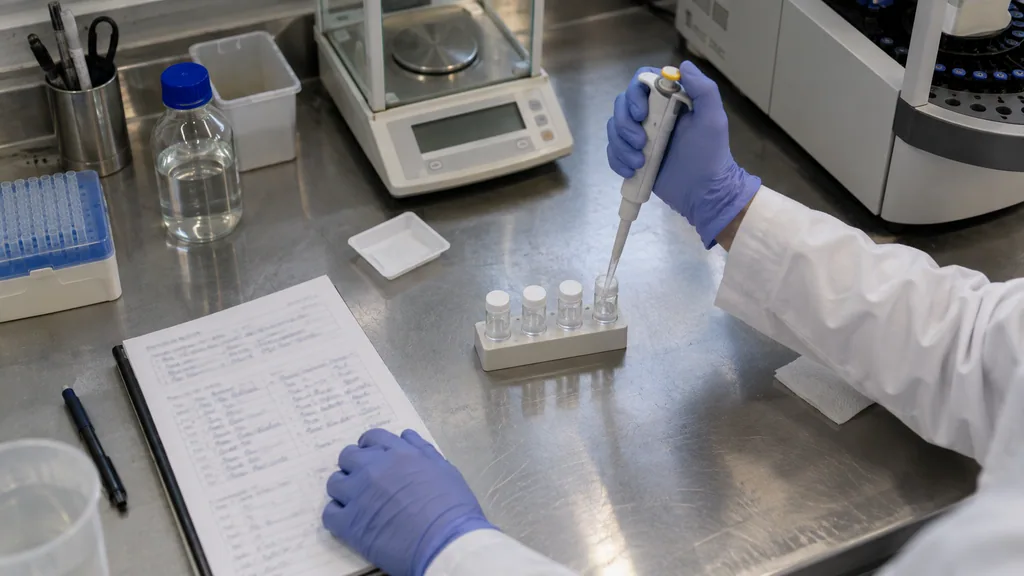
Putting three peptides in one vial is easy. Proving that the right amount of each peptide is still present, evenly distributed and stable is the real manufacturing job.
Peptide blend manufacturing must control every raw peptide, the target ratio, compatibility, uniformity and the finished batch. Separate COAs for the ingredients are not enough because blending creates a new material with its own process and stability risks.
That distinction is becoming commercially important. Names such as GLOW, KLOW and Wolverine have made multi-peptide combinations familiar to a wider audience, while laboratories and private-label buyers increasingly search for custom peptide blend manufacturers and OEM suppliers. The demand is real; the specification is often not.
This guide turns an idea like “combine A, B and C” into a sourcing brief a technical team can actually quote. It does not give treatment, injection or dosing advice. Certiva peptide materials discussed here are intended for research use and are not for human consumption.
What is peptide blend manufacturing?
A peptide blend contains two or more defined peptide components in one specified product. Depending on the legitimate intended use, that product may be a bulk research mixture, a lyophilized research vial, an analytical standard mixture or a finished cosmetic formulation using permitted cosmetic ingredients. Those categories do not share one manufacturing or regulatory pathway.
The work begins before ingredients are combined. Each peptide needs an approved identity, chemical form, specification and batch status. The manufacturer then needs a controlled calculation, dispensing method, order of addition, mixing approach, sampling plan, isolation or filling process, analytical method and packaging system.
A useful definition is therefore broader than “mixed peptides.” Peptide blend manufacturing is the documented process of turning individually controlled inputs into a reproducible combined output.
Why are peptide blends a strong search and product category?
Consumers often discover a blend through a short name and a simple promise. Business buyers search one step further: peptide blend manufacturer, custom peptide blend, private-label peptide blend, peptide blend OEM, bulk peptide blend and lyophilized peptide blend supplier.
Those phrases carry more commercial intent than a general “what are peptides” search. The buyer may already have a formula idea, a competitor reference or an audience. What is usually missing is the technical definition required to compare quotations.
That gap creates a good opportunity for a supplier that communicates clearly. It also creates risk for any seller that treats a popular nickname as a specification. “GLOW,” for example, is used online for more than one combination and ratio. The name may bring a visitor to the page, but the approved formula must determine what gets manufactured.
Our What is GLOW peptide? guide explains the naming problem. The GLOW versus KLOW comparison separates two frequently confused blend concepts, while the Wolverine peptide guide covers another common multi-peptide search. None of those nicknames should replace a line-by-line formula.
A blend is a new formulation, not a shortcut
Two raw peptides can each meet specification and still behave differently after they are combined. The new mixture may have a different pH, ionic strength, solubility, surface interaction or moisture sensitivity. One component may oxidize while another remains stable. One may adsorb to the container or precipitate as the total concentration rises.
The broader peptide formulation literature describes chemical degradation pathways including hydrolysis, oxidation, deamidation and disulfide exchange. It also describes physical changes such as adsorption, aggregation and precipitation. Which pathway matters depends on the sequence, concentration, excipients, process, package and storage condition.
This means stability data for peptide A and peptide B cannot simply be stapled together and renamed stability data for blend A+B. The combined product needs its own risk assessment and, when shelf-life claims are required, its own stability program.
Start with an exact formula, not a nickname
An OEM brief should give every component’s unambiguous name and sequence where appropriate. It should state modifications, terminal groups, disulfide bonds, counterion or salt form and any other feature that affects identity. The target amount or ratio must use a clearly defined basis.
The phrase “5 mg of peptide” can refer to gross lyophilized material, peptide content, assay-corrected amount or another calculation. Water, counterion and excipient may be part of the physical mass in a container. If the buyer and manufacturer use different bases, both can follow their paperwork and still produce the wrong ratio.
The formula should therefore state whether each target is based on net peptide content, as-is material or another agreed convention. That basis should connect to the raw-material COA, dispensing calculation, batch record and finished-product test.
Version control matters too. A formula marked “final-v6” in an email is not a reliable master record. Use one approved formula code and revision. Record who can change it and what evidence is required before the next batch uses the change.
The seven controls behind a reproducible peptide blend
| Control | The question it must answer |
|---|---|
| Raw-material identity | Is each input the intended peptide and chemical form? |
| Corrected dispensing | Was the amount adjusted for the agreed content basis? |
| Mixing process | Can the method distribute components without damaging them? |
| Sampling | Do samples represent the top, middle and bottom or the start and end of fill? |
| Component-specific analysis | Can the method distinguish and measure the intended peptides? |
| Stability | Does the combined formula remain within limits in its proposed package? |
| Traceability | Can every finished unit be connected to inputs, process records and results? |
These controls are connected. A good analytical result from one convenient sample cannot prove the whole batch is uniform. Perfect dispensing records cannot detect a degradation reaction after mixing. A stable bulk blend does not automatically prove stability after filling into a different container.
How is the target blend ratio controlled?
Ratio control begins with material status. The operator should use released lots and the current approved value for peptide content or assay when that correction is part of the formula. Scales must fit the amount being weighed; a balance designed for large quantities may not provide appropriate control for a small component.
The order of addition can matter when component amounts are very different. Adding a tiny quantity directly to a large bulk mass may create local concentration and uniformity problems. A staged dilution or solution-based approach may improve distribution, but it adds solvent, hold-time and stability considerations. The correct method depends on the physical form and the evidence behind the process.
After mixing, the sampling plan must be able to reveal nonuniformity. Samples taken only from the easiest location provide reassurance, not proof. For a filled batch, the manufacturer may need to compare units from the beginning, middle and end of the run. For a bulk mixture, spatial sampling may be more relevant.
The acceptance criteria should be written before results arrive. Moving the limits after testing turns development into storytelling.
Can HPLC measure every peptide in a blend?
HPLC can be powerful, but the word “HPLC” is not a method. The column, mobile phase, gradient, temperature, detector and sample preparation determine what the analyst can see. Two peptides may separate cleanly under one method and overlap under another. Their detector response may also differ.
A blend method needs adequate specificity. It should distinguish the intended components from one another and from relevant impurities or degradants. If two peaks co-elute, one combined area can hide a wrong ratio. Mass spectrometry may help confirm identities, but equal mass is not equal quantity, and some closely related species require additional separation or characterization.
ICH Q2(R2) describes validation characteristics for analytical procedures used for identity, assay, purity and impurity testing. A research-use program may not follow the same formal validation path as an approved drug, but the core logic remains useful: show that the method can answer the question it is being used to answer.
Our HPLC versus mass-spec testing guide explains the difference in simple terms. Buyers should request the method reference and full batch chromatogram rather than accept a standalone “99% pure” badge.
Why one purity number can hide a bad blend
Imagine a target blend with equal amounts of two peptides. A report could show a high combined chromatographic purity even if the first component is overfilled and the second is underfilled. Purity describes the relative peak profile under the method; it does not automatically prove the intended amount or ratio.
The same problem appears when the raw-material COAs are used as the only finished evidence. Those COAs show what was tested before blending. They do not show that the right lots were dispensed, that mixing was uniform, that filling was consistent or that no change occurred during the process.
A finished blend needs a finished-batch decision. The exact tests depend on the product, but the decision should connect identity, component amount or ratio where required, relevant impurity control, physical attributes and the agreed presentation.
Compatibility is sequence-specific
Peptides differ in charge, hydrophobicity, isoelectric behavior and sensitive amino- acid residues. A buffer that improves one component’s solubility may speed another component’s degradation. A metal trace may promote oxidation of a susceptible residue. A surfactant may reduce surface adsorption yet contain peroxide impurities that matter for an oxidation-sensitive sequence.
Concentration also changes behavior. A blend may have the same amount of each peptide as a single-component product while producing a much higher total peptide concentration. Higher concentration can increase self-association, viscosity or aggregation risk. Container surface area, headspace oxygen and light exposure may become more important at a different fill volume.
This is why “these peptides are commonly blended” is not a stability argument. Common use can justify investigation. It cannot replace sequence review, compatibility screening and data.
What does lyophilization change?
Freeze-drying can improve storage stability by removing much of the water, but it also exposes the formulation to freezing, concentration and drying stresses. As ice forms, the remaining liquid phase becomes more concentrated. pH and ionic conditions can shift. Peptides and excipients interact at ice-water and container surfaces.
The finished solid must then resist moisture and temperature during storage. Residual water can affect degradation and cake structure. A visually neat cake is desirable for process consistency, but it is not a chemical test. An unattractive cake does not automatically mean the peptide failed, and a perfect-looking cake does not prove the correct ratio.
For a blend, the cycle must support the complete formulation. Copying a cycle from one component may be a reasonable starting experiment, not a validated conclusion. The peptide OEM stability testing guide explains why the final formula and final package belong in the study.
Packaging is part of blend performance
Peptides can adsorb to glass, polymer, filters and tubing. Oxygen and light can drive changes in sensitive sequences. Moisture can enter through an inadequate closure. The package also determines shipping protection, label space and how well batch identity is preserved through distribution.
The manufacturer should evaluate the container and closure intended for sale or research distribution, not only a convenient development vial. A change in stopper, vial, cap, pouch or desiccant may require a documented assessment. For temperature- sensitive products, shipping qualification and temperature data should support the route and season.
Packaging also carries commercial constraints. Custom printed components may have a higher minimum order than the peptide batch. The agreement should state who owns unused labels and cartons, how they are controlled, and what happens after an artwork revision. Our peptide packaging for wholesale and OEM guide covers those practical choices.
What should appear on the blend COA?
The certificate should identify the finished blend, batch number, manufacturing or test dates, specification reference, methods, acceptance limits, results and approval status. It should connect the product to the current formula revision and package where applicable.
The results should be specific enough to support the release decision. A line that says only “peptide blend: passes” does not show which components were identified or how the ratio was checked. A total HPLC purity result may be useful, but it should not be presented as if it answers every component-specific question.
Raw-material COAs remain part of traceability. They support the identity and status of each input. They sit behind the finished COA rather than replacing it. Read our peptide COA versus specification sheet guide to see how promised limits, batch results and supporting records fit together.
OEM, ODM and custom manufacturing are different offers
In an OEM project, a buyer generally brings the product definition and the manufacturer makes it to the agreed requirements. In an ODM relationship, the manufacturer may contribute more of the formulation and product design. “Custom blend” can describe either model unless the contract makes ownership clear.
The agreement should state who owns the formula, analytical methods, stability data, artwork and improvements. It should define whether the manufacturer can offer the same formula to another customer and whether the buyer can transfer the method to a second site. Those terms affect long-term value far more than a one-time setup fee.
Our peptide OEM versus ODM guide explains the commercial difference. The peptide OEM manufacturer checklist turns it into a qualification workflow.
How to write a peptide blend RFQ that gets a real quote
Start with intended use and market category. Then identify each peptide and chemical form, the target ratio and the basis used for that ratio. State the desired batch size, presentation, excipients, container, test panel, documents, delivery location and forecast.
Explain what already exists. If the formula has only been discussed, say it is a concept. If a bench batch has been made, provide the process and data. If analytical methods exist, state whether they are transferable. If a shelf-life claim is needed, define the target condition and package.
Ask the manufacturer to separate development fees, raw materials, analytical work, stability, packaging, production and shipping. Ask which quantities are minimums for peptide material and which are minimums for printed components. Ask what event turns a tentative production window into a reserved slot.
This level of detail does not scare away capable suppliers. It prevents three cheap, incomparable quotations from becoming one expensive delay.
Red flags in a peptide blend supplier claim
A popular blend name without a formula is a marketing label, not a specification. A single COA that lists only total purity cannot prove the ratio of multiple components. An immediate shelf-life promise without the proposed formula, package and test method is not evidence. A supplier that cannot name the manufacturing and testing sites has not completed the traceability story.
Another red flag is blurred category language. Research-use supply should not be promoted as an approved treatment. Cosmetic manufacturing should use ingredients, claims and documentation suitable for the cosmetic market. Clinical or commercial drug work requires a different regulated scope. Clear boundaries make a supplier more credible, not less commercial.
How to compare two peptide blend manufacturers
Compare the same formula revision and the same quantity basis. Put the raw-material specifications, finished test panel, manufacturing site, testing site, batch size, packaging, lead time, change control and landed cost in the same view.
Then compare evidence. Has the supplier produced this exact blend or only the individual components? Can the method separate the peptides? Is uniformity supported by a sampling plan? Is the shelf life based on the final package? Does the sample come from the same route proposed for bulk?
Finally, compare what happens when something goes wrong. The best partner is not the one that promises no deviations. It is the one with a clear process to document, investigate, communicate and correct them.
The bottom line for buyers
A peptide blend is a product in its own right. Its quality does not equal the average quality of its ingredients. The manufacturer must control the inputs, calculation, mixing, sampling, component-specific analysis, stability, packaging and traceability as one connected system.
For brands, that rigor is commercial. It creates a formula that can be quoted, scaled, reordered and defended. For laboratories, it improves reproducibility. For distributors, it makes batch documents easier to review and customer questions easier to answer.
Certiva reviews research-use bulk, wholesale and suitable custom peptide blend OEM inquiries. Send your formula, target ratio, batch size, test panel and packaging brief for review. If the formula is still a concept, say so; the first useful deliverable may be a development scope rather than a production promise.
Sources and further reading
The review Designing Formulation Strategies for Enhanced Stability of Therapeutic Peptides in Aqueous Solutions explains peptide oxidation, hydrolysis, deamidation, adsorption, aggregation and other formulation risks. Physicochemical and Formulation Developability Assessment for Therapeutic Peptide Delivery connects those risks to pH, buffers, excipients, concentration, containers and processing.
ICH Q2(R2) provides the current harmonized framework for analytical procedure validation. ICH Q1A(R2) describes the general stability-testing framework for new drug substances and products. Their formal application depends on the product category and market; they are cited here for analytical and stability principles, not to imply that a research-use blend is a regulated medicine.
This article is educational and concerns research materials, quality and manufacturing. It is not medical advice and does not provide dosing, injection or treatment instructions.
Frequently asked questions
What is peptide blend manufacturing?
Peptide blend manufacturing combines two or more defined peptide materials into one controlled research or finished-product format. A credible process qualifies each input, controls the target ratio and uniformity, evaluates compatibility and tests the finished blend rather than relying only on separate raw-material COAs.
Can two stable peptides become unstable when blended?
Yes. A blend creates a new chemical and physical environment. The components may change pH, ionic strength, solubility, oxidation risk, surface adsorption or aggregation behavior, so stability data for each peptide alone cannot automatically support the combined product.
How is the ratio of a peptide blend verified?
The manufacturer should combine controlled dispensing and mixing records with a suitable analytical method that can distinguish and quantify the components. The method, sampling plan and acceptance limits must fit the actual sequences and intended product category.
Is one HPLC purity number enough for a peptide blend?
No. One total purity percentage may hide the identity, amount and degradation profile of each component. Finished-blend testing should confirm the intended components and use methods capable of separating relevant peaks, with assay or content testing where required.
What should a custom peptide blend OEM request include?
It should define every peptide and chemical form, target ratio, batch size, product category, excipients, presentation, test panel, stability plan, packaging, labels, documents, forecast, change control and ownership of formula and analytical methods.
Does Certiva offer peptide blends for personal use?
No. Certiva reviews research-use bulk, wholesale and suitable OEM blend inquiries. Research materials are not for human consumption, and a blend name or vial format does not make a product an approved medicine.
For research use only. Not for human consumption. This article is educational and makes no medical, therapeutic, or dosing claims.
← More sourcing & supply guides · Have a question? Start an inquiry →