


It has a superhero name for a simple reason: Wolverine makes people think of building back fast.
The wolverine peptide is the popular name for a BPC-157 + TB-500 research blend.
It is not one mystery peptide. It is a two-peptide combination built around connected muscle, tendon, cell-movement, and tissue-repair research themes. Buyers may also see it called Wolverine peptides, Wolverine stack peptide, Wolverine blend, or BPC-157 Wolverine.
What is inside the Wolverine peptide?
The Wolverine peptide blend contains:
- BPC-157, a 15-amino-acid peptide studied in muscle-injury, tendon-cell, connective-tissue, and other repair models; and
- TB-500, a research peptide related to thymosin beta-4 studies involving actin, cell movement, and vascular signaling.
Think of it as a two-person repair-research team. Each member has its own role, but the two are often ordered together when a project calls for a fixed combination.
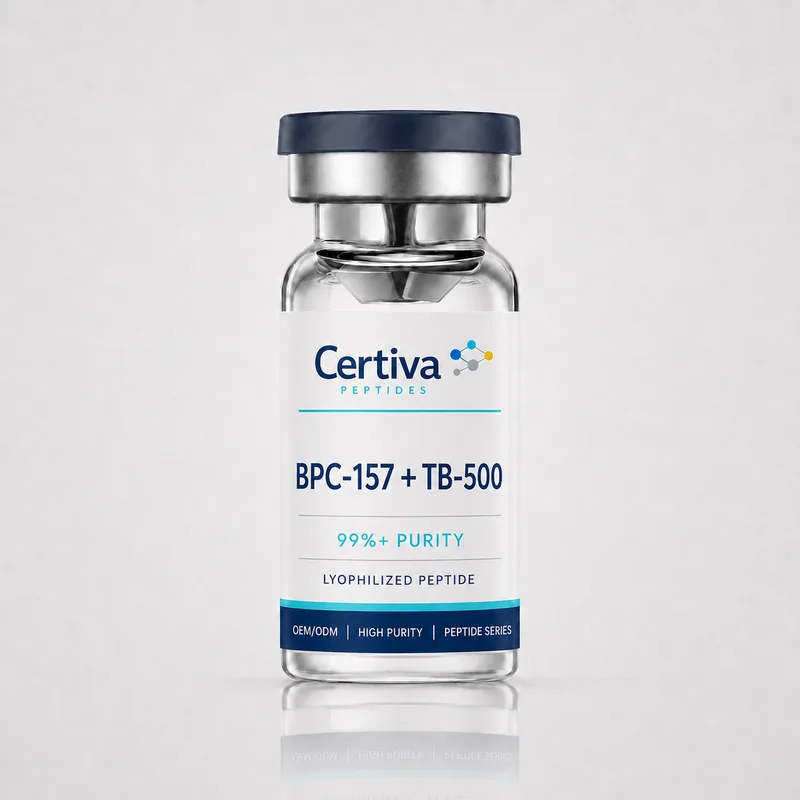
Certiva supplies the BPC-157 + TB-500 Wolverine blend as a lyophilized research reference. It is labeled for research use only and is not for human consumption.
Why is it called the Wolverine peptide?
The nickname comes from the comic-book character known for rapid healing. It is a memorable market name, not a new scientific peptide name.
That distinction makes buying easier. If a supplier lists “Wolverine,” check the composition panel. It should clearly state how much BPC-157 and how much TB-500 are inside the vial.
The name gets attention. The composition and COA make the order clear.
Why are BPC-157 and TB-500 paired?
Their research stories meet around repair and rebuilding:
- A BPC-157 rat muscle-injury study reported improved healing measures and return of muscle function.
- BPC-157 tendon-cell research reported increased fibroblast movement, spreading, and survival under stress.
- Thymosin beta-4 research has examined actin, cell migration, angiogenesis, and vascular signaling in cell and animal models.
That gives the Wolverine stack an easy-to-understand theme: one vial brings together two research references associated with connected parts of tissue-repair work. Read the BPC-157 muscle study, BPC-157 tendon-cell study, and thymosin beta-4 cell-migration study.
For a simple side-by-side explanation, see BPC-157 vs TB-500.
Which Wolverine blend size can I order?
Certiva’s stocked compositions are easy to read:
- 10 mg total: 5 mg BPC-157 + 5 mg TB-500;
- 20 mg total: 10 mg BPC-157 + 10 mg TB-500; and
- 10 vials per standard box.
Bulk quantities and custom ratios are available by inquiry.
Do not look at the total mass alone. A “10 mg” blend should also tell you how those 10 milligrams are divided between its two peptides.
What should the Wolverine peptide COA show?
A useful Certificate of Analysis should connect the test results to the exact blend and batch being offered. Look for:
- the product name and batch number;
- the stated BPC-157 and TB-500 composition;
- an HPLC purity result;
- mass-spectrometry identity information;
- test dates and the responsible laboratory or quality unit.
Use the five-minute peptide COA checklist if you want a plain-English way to review the document.
How do I order Wolverine peptide?
Send Certiva five details:
- 10 mg, 20 mg, bulk, or a custom ratio;
- number of vials or total quantity;
- destination country;
- COA, packaging, or custom-label needs; and
- target order date.
We will reply with current availability, the applicable batch information, lead time, and a quote.
Request the Wolverine blend COA + quote →
Treat the blend as two defined components
The wolverine peptide is BPC-157 + TB-500 in one research blend.
The nickname is memorable, but smart buyers compare the amount of each peptide, the batch COA, vial quantity, lead time, and repeat-order support.
Our peptide blend manufacturing guide explains why separate raw-material COAs do not replace ratio control, uniformity, compatibility and testing of the finished blend.
Sources and further reading
- PubMed: BPC-157 in a muscle-healing research model
- PubMed: BPC-157 and tendon-fibroblast movement
- PubMed: thymosin beta-4, cell migration, and angiogenesis
Frequently asked questions
What is the Wolverine peptide?
The Wolverine peptide is the popular name for a BPC-157 + TB-500 research blend. It combines two peptides discussed in muscle, tendon, cell-movement, and tissue-repair research.
Is Wolverine one peptide?
Wolverine is a blend name, not the name of one peptide. The standard pairing contains BPC-157 and TB-500 in one fixed-composition vial.
What is in a Wolverine peptide blend?
Certiva's stocked Wolverine blend is available as 10 mg total with 5 mg BPC-157 plus 5 mg TB-500, or 20 mg total with 10 mg of each peptide. Custom ratios are available by inquiry.
Why are BPC-157 and TB-500 paired?
The two peptides are paired because their research themes connect. BPC-157 appears in muscle-injury, tendon-cell, and local tissue-repair models, while thymosin beta-4-related research examines actin, cell movement, and vascular signaling.
How do I order Wolverine peptide research blend?
Send the required vial size, quantity, destination country, and documentation needs. Certiva will provide current availability, the applicable batch COA, lead time, and a quote.
For research use only. Not for human consumption. This article is educational and makes no medical, therapeutic, or dosing claims.
← More sourcing & supply guides · Have a question? Start an inquiry →